
Bites between Hermann’s tortoises are not a matter of “character.” They indicate a dysfunction in the spatial, social, or sexual organization of the group. Understanding the precise mechanism behind each type of bite allows for action on the correct variable, rather than separating individuals by default without addressing the cause.
Sex ratio and male harassment in Hermann’s tortoise
An imbalance in the male/female ratio is the primary cause of severe bites in captivity. The male Hermann exhibits aggressive courtship behavior: he bumps into the female’s shell, chases her, and bites her hind legs, tail, and head to force her to mate.
When several males coexist with a single female, or when the ratio exceeds one male for two females, harassment becomes continuous. The female no longer has a period of rest. Bites accumulate, causing open wounds on the limbs and neck area, and can lead to chronic stress with cessation of feeding.
The documented case from Golem Grad Island in Macedonia illustrates this phenomenon to the extreme. On this isolated island, an observed ratio of about one hundred males for a single female capable of laying eggs led researchers to describe the situation as “demographic suicide.”
The brutality of the males (continuous biting and harassment) gradually eliminates the reproductive females, leading to the self-destruction of the population. This case, reported by Science & Vie, is the first known example where reproductive violence leads to the local extinction of a tortoise population.
To better understand why Hermann’s tortoises bite each other, we recommend always analyzing the sex ratio of the group before any other hypothesis.
Density and enclosure size: critical threshold for bites
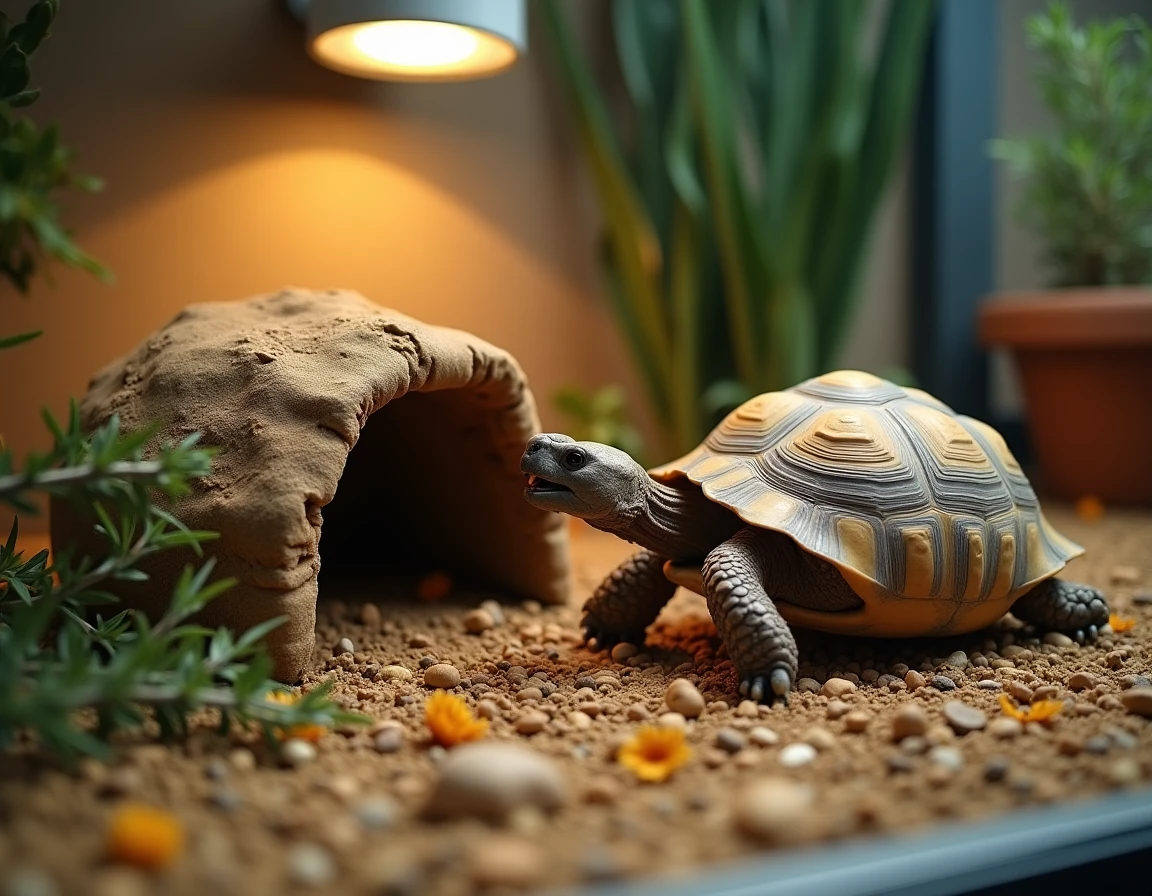
Field observations, including those from Golem Grad, confirm that impossible escape exacerbates aggressive behaviors. In closed environments (island, enclosure, terrarium), the combination of high density and the impossibility of dispersal triggers bites that are much more frequent and violent than in an open habitat.
In captivity, we observe the same pattern in enclosures that are too small. Two adult Hermann’s tortoises in a space of less than one square meter replicate the conditions of a closed environment with no escape. The dominated tortoise cannot avoid attacks, perpetuating a cycle of constant aggression.
Bites between individuals of the same sex can also be explained by territorial competition. Two males in a confined space bite each other’s legs and heads to establish a hierarchy. Two females may also bite around food points or thermoregulation areas when the enclosure offers only a single heat spot.
Parameters to check before any separation:
- The actual ground area available per individual (not just the total surface, but the space effectively accessible free of obstacles, hiding spots, and water areas)
- The number of distinct feeding stations, spaced sufficiently apart for two tortoises to eat without crossing paths
- The number of thermoregulation zones (hot spots under lamps or in the sun), which must be at least two for two individuals
- The presence of visual barriers (flat stones, earth mounds, dense plants) that allow one tortoise to move out of the other’s line of sight
Bites among juvenile Hermann’s tortoises: food competition
In juveniles, the motivation for bites differs. Courtship behavior does not yet exist. Food competition is the main trigger among young Hermann’s tortoises.
A juvenile that bites a conspecific on the head or front legs usually does so in immediate proximity to food. We observe this behavior as soon as the food resource is concentrated in a single point. Juvenile Hermann’s tortoises do not have the concept of “sharing”: the first to arrive actively defends the area.

The solution does not lie in systematic separation, but in increasing the distribution points. Placing food in three or four distinct locations within the enclosure significantly reduces confrontations. For juveniles raised in groups, spreading food eliminates the majority of feeding bites.
Different species in the same enclosure: interspecific bites
Housing Hermann’s tortoises with other species of terrestrial tortoises (Testudo graeca, Testudo marginata) increases the risk of bites. Each species has different courtship behaviors, tolerance thresholds, and thermal needs. A male Testudo graeca, for example, may harass a female Hermann with an intensity that she does not normally experience from her conspecifics.
Interspecific bites are also a vector for the transmission of pathogens (notably herpesvirus). Co-housing different species of Mediterranean terrestrial tortoises is not recommended, even when the size of the enclosure seems sufficient.
Separation protocol and reintroduction after bites
When a bite has caused a visible wound, immediate separation is necessary. The injured tortoise should be placed in a calm, clean, and warm environment to promote healing. Open wounds on the limbs or head require disinfection with diluted betadine and, in the case of deep bites, a visit to a veterinarian specialized in reptiles.
Reintroduction should only occur after correcting the triggering factor:
- Adjustment of the sex ratio (permanent removal of a male if the imbalance is structural)
- Enclosure enlargement or addition of visual barriers
- Multiplication of resources (food, water, warm areas)
Reintroducing without modifying the environment reproduces the same bites in the following days. Aggressive behavior is not an individual trait in Hermann’s tortoise: it is a response to spatial, social, or food constraints that the breeder has the ability to correct.